

In this article (13 sections)
Quick answer: RankMeHi re-checked every llms.txt file found on 151 of 489 live Orange County local business websites in November 2026. In our study, 127 were real files and 88.2% start with the one part the format requires, a title, but only 63% have a title, a summary and links. 11% refused or challenged us when we asked for the file with an AI crawler's name. No AI engine has said it uses the file, so treat it as a cheap extra.
A business owner opens their site's llms.txt for the first time and finds a page of links to old services and a phone number that has changed. They didn't write it. A plugin did, one update ago, and nobody looked at it since.
That is the file most local businesses have, if they have one. 151 of the 489 live sites in our 662-business Orange County website study answered at /llms.txt in September. RankMeHi is a web design and local SEO company in Costa Mesa, California, and we wanted to know what those files actually contain, who wrote them, and whether the sites behind them welcome the AI bots they're written for. For 1 site in 9, the file says come in and the door says not you.
Not sure what your llms.txt says? We'll read it, test your site with the AI crawlers' names and tell you what to fix, even if you never hire us. Get a free website check
How we checked the llms.txt files on 151 local business sites
Short answer: we asked each site for its /llms.txt file again in November 2026, read what came back, followed up to 25 links in each file, and repeated the request with three AI crawlers' user-agent names.
The sample is the same OpenStreetMap list of Orange County, California businesses behind our earlier study, with chains removed. Our September crawl counted 489 live sites and flagged 151 with an llms.txt file (30.9%). We went back to those 151 in November. Here is what came back, with every denominator in one place:
| What we found in November 2026 | Sites | Share of 151 |
|---|---|---|
| A real text file at /llms.txt | 127 | 84.1% |
| The address now returns a web page, not a file | 1 | 0.7% |
| File gone (HTTP 404 or 410) | 10 | 6.6% |
| Blocked our request (HTTP 401, 403 or 429) | 1 | 0.7% |
| Timeout or connection error (not counted either way) | 12 | 7.9% |
Source: RankMeHi llms.txt audit, November 2026. All shares in this article are of the 127 real files unless the table says otherwise.
Three limits you should keep in mind:
- It's a sample, not the market. One county, listed sites only. Don't read these shares as national numbers.
- The bot test is a name, not a crawler. We sent a request from one address with the user-agent names GPTBot (OpenAI), ClaudeBot (Anthropic) and PerplexityBot (Perplexity). Real crawlers come from known address ranges, and some security tools treat them differently. A refusal means our test was refused, not that a real crawler would be.
- Broken means broken from here. We counted HTTP 404, 410 and no connection. Answers like 403 or 429 are counted separately as blocked, because many sites refuse automated link checks.
What llms.txt is, and what Google and the studies say about it
Short answer: llms.txt is a plain markdown file at the root of a site that summarizes the site and lists its key pages for language models; no major AI company has confirmed it uses the file.
The llmstxt.org proposal from September 2024 describes it. The only required part is a title, an H1. After that come an optional summary in a quote block, optional text, and sections with lists of links.
Google has been blunt about it. John Mueller said in 2025 that no AI system currently uses llms.txt, and Google's search team has said it does not endorse the file. SE Ranking looked at nearly 300,000 domains and found no clear link between having the file and being cited in AI answers; about 10% of those domains had one. Our local sample shows 30.9%, but the samples differ, so don't compare the two numbers directly.
That gap sets up our question. If the file doesn't change what AI engines cite, why do so many local sites have it, and is it any good?
What is inside the llms.txt files local businesses publish
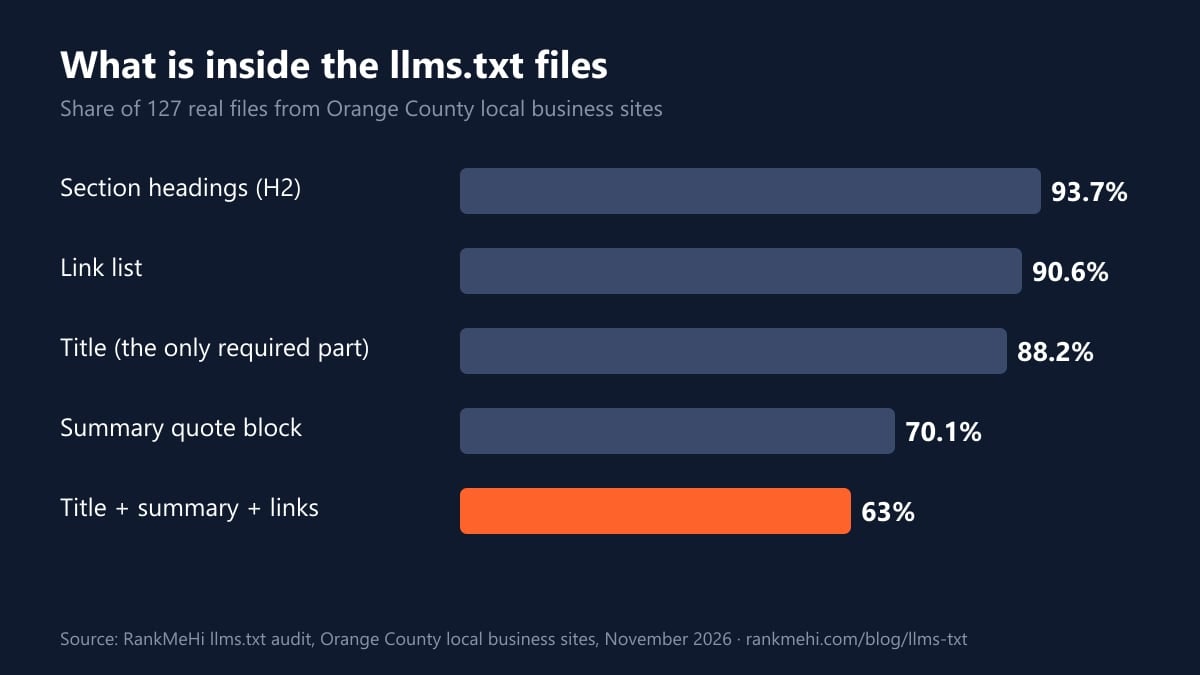
Short answer: most start with a title, and about 6 in 10 are complete by our measure, with a title, a summary and links.
| What the file contains | Files | Share of 127 |
|---|---|---|
| A title (H1), the only part the format requires | 112 | 88.2% |
| A short summary in a quote block | 89 | 70.1% |
| At least one list of links | 115 | 90.6% |
| Section headings (H2) | 119 | 93.7% |
| Title, summary and links together | 80 | 63% |
| Under 200 bytes (a stub) | 6 | 4.7% |
Source: RankMeHi llms.txt audit, November 2026. The format requires only the title; "complete" is our stricter measure.
Use this chart on your site
Free to use under CC BY 4.0. Please credit RankMeHi with a link to this page. Copy the code:
The median file runs 490 words and lists 10 links. 12 of the 127 have no link list at all, which makes them a title and some prose, not a guide to anything.
A file that is 63% complete isn't a failure. The format is short and forgiving, and that's the point of it. The risk is staleness: a file written once and never read again keeps pointing at whatever the site looked like that day.

Check yours in five minutes: open yoursite.com/llms.txt. Read the first three lines and the first five links. If the summary is wrong or a link is dead, a customer or a model reading it sees the same thing you do.
Who wrote the llms.txt files: plugins and website builders
Short answer: about 7 in 10 files likely came from a plugin or a website builder, not from the business owner.
We looked for plugin names in the files themselves, and we noted when the site runs on a hosted builder that offers the file. A builder match is a likely source, not proof for that file.
| Where the file seems to come from | Files | Share of 127 |
|---|---|---|
| No generator sign | 36 | 28.3% |
| Site on Wix | 26 | 20.5% |
| Yoast plugin text in the file | 21 | 16.5% |
| Site on GoDaddy Builder | 11 | 8.7% |
| Site on Shopify | 11 | 8.7% |
| Site on Duda | 7 | 5.5% |
| AIOSEO plugin text in the file | 6 | 4.7% |
| Rank Math plugin text in the file | 5 | 3.9% |
| Site on Squarespace | 3 | 2.4% |
| Site on Webflow | 1 | 0.8% |
Source: RankMeHi llms.txt audit, November 2026. "Likely automatic" is 91 of 127 files (71.7%); 36 files (28.3%) show no sign of a generator, and some of those were probably written by hand.
The pattern by platform is where it gets interesting:
| Website platform | Files | With title, summary and links |
|---|---|---|
| WordPress | 40 | 27 of 40 (67.5%) |
| Wix | 26 | 24 of 26 (92.3%) |
| Custom or unknown | 20 | 9 of 20 (45%) |
| GoDaddy Builder | 13 | 13 of 13 (100%) |
| Shopify | 11 | 0 of 11 (0%) |
| Duda | 7 | 0 of 7 (0%) |
Source: RankMeHi llms.txt audit, November 2026. Platforms with fewer than 7 files are left out.
A file made by a tool isn't bad. It's just not a decision. The WordPress files depend on whichever SEO plugin was installed, and the quality follows that plugin's defaults. Files from Shopify and Duda sites in our sample had a title and links, but no summary quote block, so none met our "complete" measure. That's a template choice, not a business owner's choice.
How many links inside llms.txt files are broken?
Short answer: most files have working links, but 7 of 115 files with links contain at least one that is gone.
We checked up to 25 unique links per file: 1621 links in 115 files. 31 of them were broken (HTTP 404, 410 or no connection), which is 6.1% of the files that had links. Another 37 refused our request with a 401, 403 or 429, and we did not count those as broken.
The share is small, and it's also the one number in this study where the harm is easy to explain. A model or a person who follows the link finds nothing. A file the business never reads can't tell you that a service page moved.
Check yours in five minutes: click every link in your file. Fix or remove any that fail, and send the file's author a note if a plugin produces it.
Do sites publish llms.txt and turn AI bots away?
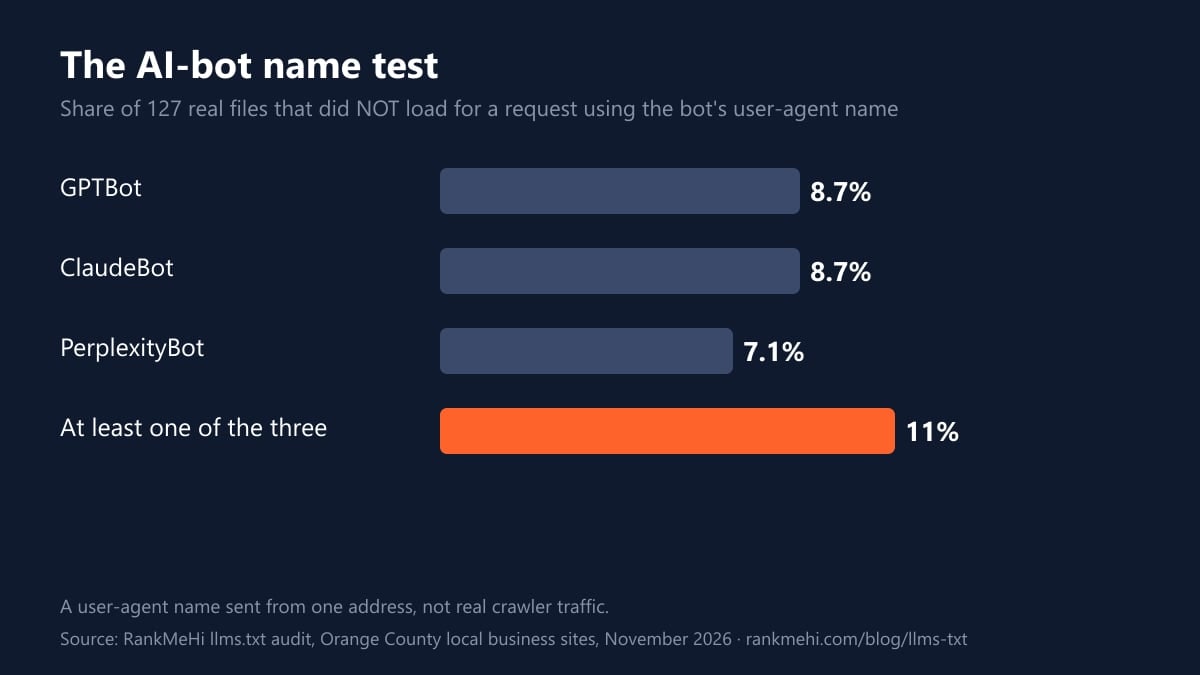
Short answer: 14 of 127 sites (11%) answered at least one of our AI-bot tests with a block page, a 403 or an error, while the same file loaded for a normal browser.
For each real file we requested it again with a bot name. Here is what happened:
| User-agent name we sent | Files not served | Share of 127 |
|---|---|---|
| GPTBot | 11 | 8.7% |
| ClaudeBot | 11 | 8.7% |
| PerplexityBot | 9 | 7.1% |
| At least one of the three | 14 | 11% |
Source: RankMeHi llms.txt audit, November 2026. A user-agent test from one address, not real crawler traffic.
Use this chart on your site
Free to use under CC BY 4.0. Please credit RankMeHi with a link to this page. Copy the code:

Our September crawl showed the same pattern for 12 of these sites, so it isn't a one-off. We don't know which of those sites chose this. A security setting, a hosting plan or a plugin may have done it for them. Our earlier AI crawlers study found that few sites block AI bots in their robots.txt file (the standard behind it is RFC 9309) and that the blocking happens at the security layer; this adds a plain version of it: the file that says "read me" sits behind a door that might say no.
If you want AI assistants to read your site, one test tells you more than the file does. Ask for your pages with those same bot names and see what comes back.
Does llms.txt help you get cited by AI? What we can and can't say
Short answer: we can say what the files contain and whether they load; we can't say whether any AI engine uses them, and nobody outside those companies can.
Our test doesn't measure citations. It checks files, links and access. Google's John Mueller has said no AI system uses it, and the largest public study we found saw no clear effect. So our view is simple: llms.txt is a cheap, optional extra, and a file with wrong facts is worse than none.
We run the same checks on our own file. RankMeHi's llms.txt at rankmehi.com has a title, a summary, 7 sections and 30 links; none of the 25 we checked were broken, and all three of the three bot-name tests got the file. It was last modified on 21 November 2026. That's one site and a point in time, not a guarantee. If it drifts, you can check us.
What to do about llms.txt: a five-step order
Short answer: fix access first, then facts, then links, then structure, and only then decide whether you want a file at all.
The five steps, in order
- Request your site with an AI bot's name (GPTBot, ClaudeBot, PerplexityBot) and note what comes back. *Out of order:* a perfect file behind a block page reaches nobody.
- Read your file as a customer would. Fix the summary, the phone number and every service that no longer exists. *Out of order:* fixing links first sends readers to the wrong place faster.
- Click every link and remove or repair the dead ones. *Out of order:* links to pages that will later move have to be fixed twice.
- Add the missing parts a good file has: a one-paragraph summary in a quote block, and sections with links to your main service pages. *Out of order:* structure on top of old facts hides errors under a tidy layout.
- Decide who owns it. If a plugin writes it, put a reminder to read it each quarter; if you write it, keep it short. *Out of order:* nothing breaks, but without an owner it goes stale again.
Why the order matters, and what it costs
Do step 2 before step 1 and you've repainted a sign on a door that stays locked; skip step 2 and you've unlocked the door onto the wrong address. In our experience, steps 2 to 5 take under an hour for a small site. Step 1 takes a minute with a tool, and longer if your host or security plugin needs a setting changed.
For the wider picture of what AI search looks at, our answer engine optimization guide covers the pages and facts that matter more than any single file, and our AI search optimization service covers the work behind it.
When llms.txt isn't worth your time
Short answer: if your site is missing basic pages, loads slowly, or hides its phone number, fix those before you touch llms.txt.
We have measured those problems too. In our local business website statistics, 26.4% of live sites had no tap-to-call link and 24.9% had no form or booking. A customer who can't call you won't be rescued by a file for machines. If your basics are in place and you use a plugin that writes the file, read it once and move on.
What RankMeHi does about llms.txt and AI crawlers
Short answer: a free check first, then a fixed-price fix if you want one.
Our free website check includes your llms.txt file, the bot-name test above, and the basics a customer sees. If you want us to fix what we find, our AI readiness sprint starts from $390 and takes under a week, and audit and fix work starts from $490. You see the price before anything starts. Whenever we design a website or build one, we make sure the files that describe it match the pages that exist.
Key takeaways
- RankMeHi's November 2026 audit found 127 real llms.txt files among 151 flagged live Orange County local business sites.
- 88.2% have a title, the only required part; 63% have a title, a summary and links.
- About 71.7% likely came from a plugin or a website builder, and 7 of 115 files with links hold a broken one.
- 11% turned away at least one of our AI-bot tests; it was a user-agent test, not real crawler traffic.
- No AI engine has confirmed using llms.txt; keep the file short, true and checked.
FAQ
What is llms.txt?
llms.txt is a markdown file at the root of a website, at yoursite.com/llms.txt, that summarizes the site and lists its main pages. The proposal came out in September 2024. Only a title is required; a summary and sections of links are optional. It's meant to help language models read a site.
Does llms.txt help you rank or get cited by AI?
No one has shown that it does. Google has said no AI system uses it, and a study of nearly 300,000 domains found no clear link to AI citations. In our audit of 127 local files, we measured contents, links and access, not citations. Treat it as a cheap extra.
Do I need an llms.txt file for my local business?
No. It's optional, and your customers don't see it. If your plugin or website builder already creates one, read it once for wrong facts and dead links. If you don't have one, fix your phone link, forms, speed and pages first.
How do I check my llms.txt file?
Open yoursite.com/llms.txt in a browser. Check that the title and summary are true, click each link, and make sure the address returns a text file, not a web page. Then request it with an AI crawler's user-agent name to confirm your security settings don't turn it away.
Why did our site block AI bots?
Often it's a setting nobody chose: a security plugin, a hosting plan or a bot filter. In our test, 11% of sites with a file refused at least one bot name, and we can't say who decided. Ask your host or developer which rules apply to GPTBot and ClaudeBot.
What should an llms.txt file contain?
A title with the business name, a one-paragraph summary in a quote block, and a few sections of links to your main pages, each with a short description. Keep every fact true: phone number, services, service area. Our own file has a title, a summary, 7 sections and 30 links.
Cite this study
RankMeHi, "llms.txt Study: We Checked 127 Local Business Files," November 2026. Sample from the RankMeHi 662-site Orange County local business website study; files re-checked in November 2026. More numbers from the same sites: local business website statistics. You may use the charts with a link to this page.
Find out what your files say. We'll read your llms.txt, test your site with the AI crawlers' names and send the fixes in order. Get a free website check
Services mentioned in this article
RankMeHi designs and builds business websites, then makes sure they are found and convert. Start with the two pages below.
Keep reading

AI Crawlers and Local Business Websites: Owners Rarely Block Them, Firewalls Do
AI crawlers on 489 local business sites: robots.txt blocked them on just 4, but 14% of firewalls refused them. How to check your site and which bots to allow.
Read article
We Tested 662 Local Business Websites in Orange County. Here's What Actually Works
Local business website study 2026: we tested 662 Orange County sites. 15% don't load, 26% lack tap-to-call and only 7% pass Google's mobile speed test.
Read article
Answer Engine Optimization: How to Be the Answer, Not the Tenth Blue Link
Answer engine optimization for business owners: how Google AI, ChatGPT and voice pick one answer, what we found testing five sites, and a 10-step checklist.
Read article
Generative Engine Optimization: How to Get Your Business Cited by ChatGPT, Gemini and Google's AI
Generative engine optimization gets your business cited by ChatGPT, Gemini and Google AI Overviews. What GEO is, how it differs from SEO, and a 30-day plan.
Read article