
A customer finds you on a map app, taps the phone number and hears "this number is no longer in service". Your website shows a different number. Google sees the same confusion, and so do the AI assistants that now answer "who's a good plumber near me".
That's what local citations are supposed to prevent. Citations are the places your business name, address and phone number (NAP) appear: map listings, directories, review sites and your own website. This week we compared the homepages of 404 Orange County businesses with their map listings to see how many actually match. Here's what we found and how to fix yours in order.
 The number on the map listing is the one customers dial. It has to match the website.
Quick answer: Local citations are mentions of your business name, address and phone number (NAP) on other sites: Google Business Profile, Apple, Bing, Yelp, directories and your own website. In our test of 404 Orange County businesses, only 60% showed the same phone number, street number and ZIP on their homepage as on their map listing.
Want to know which of your listings disagree? We'll compare your website with your main listings and send you the mismatches in fix order, free. Get my free audit
What we tested
We compared the homepage of 404 single-location Orange County businesses with their map listing.
- Sample: businesses from our study of 662 Orange County business websites whose OpenStreetMap listing includes a phone number. OpenStreetMap is the open map data the study was built from and that many apps and services reuse.
- Chains removed, and only single-location businesses kept, so each has one true phone number.
- Fetched: each homepage in October 2026.
- Compared: the phone numbers in the page and the listing's street number and ZIP code.
This is a test of the website against the map listing. We didn't log in to anyone's Google Business Profile.
What we found
Most businesses showed the right phone number. Far fewer got name, address and phone all right.
| Check | Result |
|---|---|
| Homepage shows the same phone as the listing | 71% (286 of 404) |
| Homepage shows only a different number | 13% (53); 20 of them show two or more |
| No phone number in the page HTML | 16% (65); 12 show it only after JavaScript runs |
| Homepage shows the listing's street number and ZIP | 69% of 409 with an address |
| Full match: phone, street number and ZIP | 60% (217 of 364) |
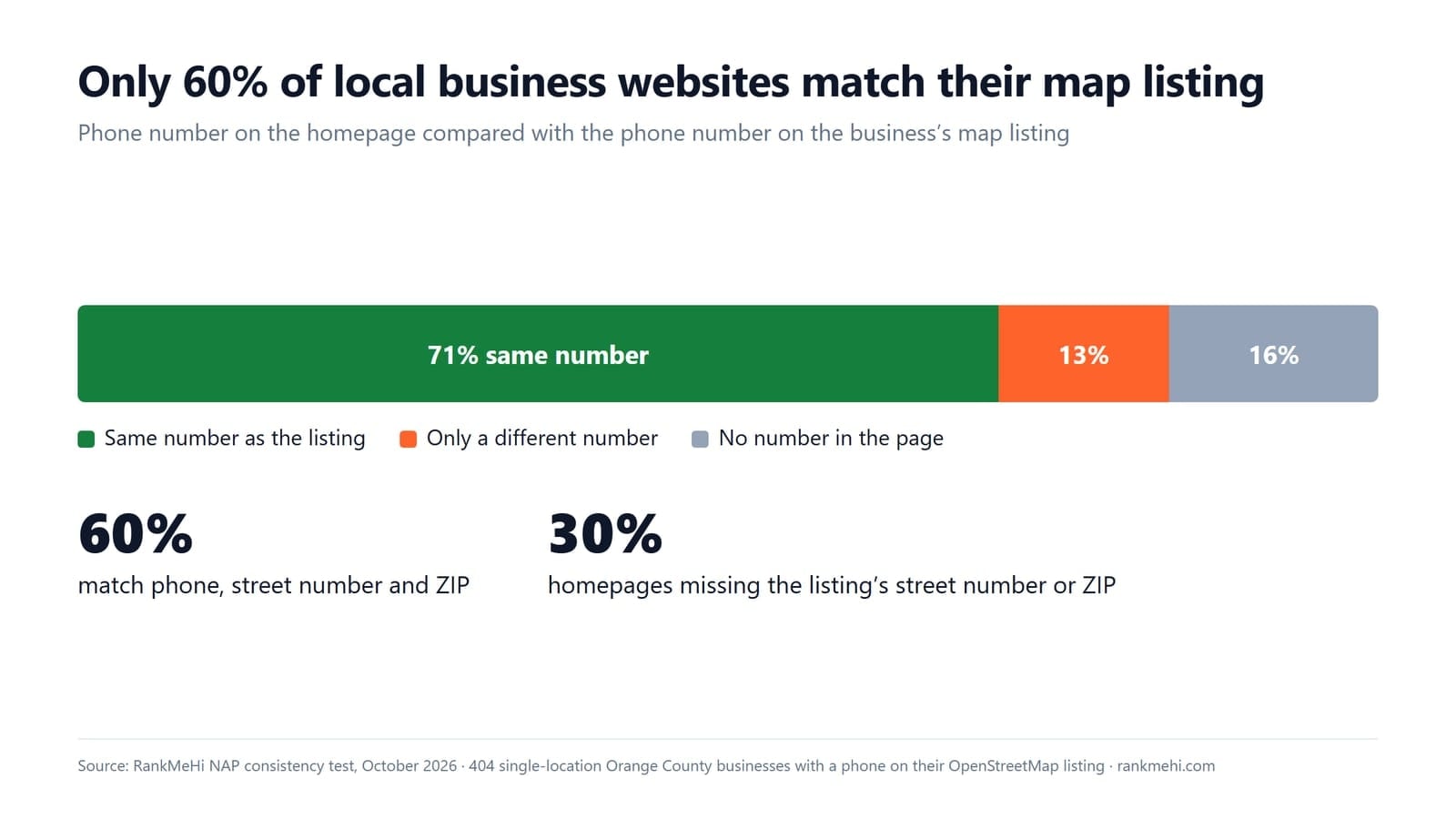 Only 60% of homepages matched their map listing on phone, street number and ZIP.
So four in ten of these businesses send customers, search engines and AI assistants at least one conflicting or missing detail. Two findings stand out:
- 13% show only a different number. Twenty of them show two or more numbers, which usually means call tracking numbers, an old line or a separate sales line.
- 16% have no phone number in the page code at all. Twelve of those only show it after JavaScript runs, and the rest hide it in an image or leave it off the homepage.
Which industries keep their details straight
Health and dental practices matched most often; retail, beauty and craft businesses least.
| Industry group | Homepage phone matches listing |
|---|---|
| Health and dental | 82% (106 of 129) |
| Auto repair | 77% (24 of 31) |
| Legal, real estate and finance | 68% (52 of 76) |
| Trades, crafts and home services | 68% (40 of 59) |
| Retail, beauty and other | 59% (64 of 109) |
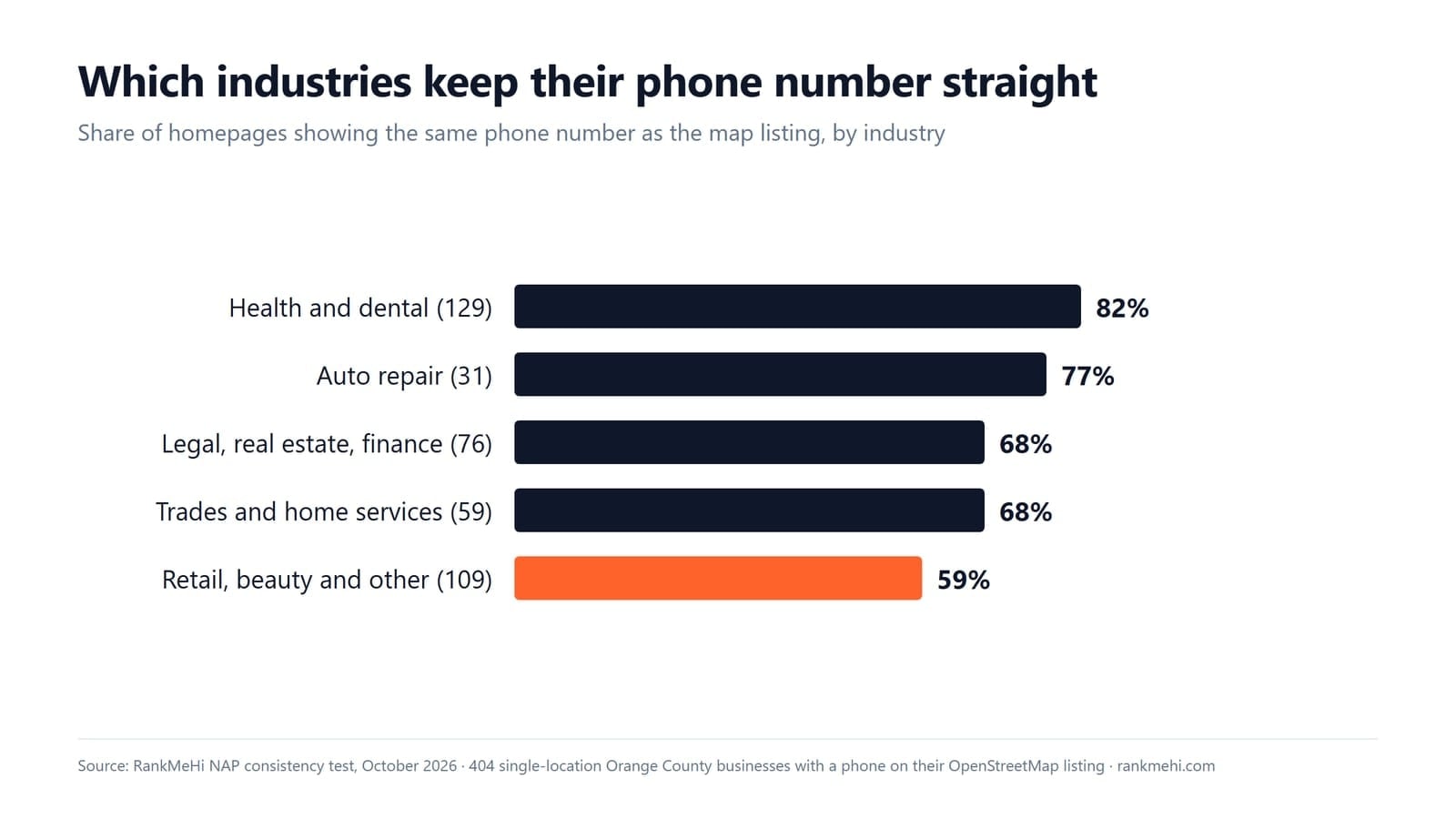 Health and dental practices kept their numbers straightest; retail and beauty drifted most.
We can't prove why health practices score highest. Our guess: patients call one front-desk number, so practices guard it. The trades and crafts group is a mix of contractors, caterers, photographers and similar businesses, so read it as a rough signal.
Why NAP mismatches happen
Almost every mismatch we looked at traced back to one of five causes.
- Call tracking numbers that replaced the main number across the whole site.
- A move or new phone system that never reached every listing.
- Old directory listings nobody has claimed in years.
- A franchise or marketing vendor that created listings with its own numbers.
- A number that only renders with JavaScript, or sits inside an image instead of text.
Small formatting differences don't matter: "Ste" versus "Suite" or "(949)" versus "949-" are fine. A different number or a different street address is not.
Do local citations still matter in 2026?
Yes, but more for the phone ringing than for rankings.
Citations are a smaller ranking factor than reviews, categories and how close the business is to the searcher. What they still do is decide whether the customer who found you reaches you. A wrong number costs the call directly, and conflicting details confuse the map apps and AI assistants that pull from many sources at once.
Think of NAP consistency as hygiene. It won't lift you to the top of the map by itself, but inconsistent details can hold back everything else you do in local SEO.
The best review in the world doesn't help if the number under it rings a disconnected line.
The citations that matter most
Start with the listings most likely to send you a customer, then the ones that feed other sites.
| Listing | Why it matters |
|---|---|
| Google Business Profile | The map pack and most "near me" calls; see our optimization guide |
| Apple Business Connect | Apple Maps and Siri on every iPhone |
| Bing Places | Bing, and the services that build on Bing's results |
| Yelp | Reviews many people check, and a source other apps reuse |
| Where many customers look for hours and a phone | |
| Better Business Bureau | Trust checks before bigger jobs |
| Your industry's main directory | Where people in your trade compare options |
| Data aggregators | Feed dozens of smaller directories at once |
We learned this the hard way ourselves: in September 2026 we found that RankMeHi had no claimed Bing Places listing at all. We're fixing it. It happens to agencies too, which is exactly why a scheduled check beats good intentions.
Citation building means claiming each of these once and keeping it accurate, not buying hundreds of low-quality directory entries. A paid citation service can save time for a business with many locations, but for a single shop the first eight listings above, kept correct, cover most of what customers and search engines see. Before paying anyone, ask which listings they will create, who owns the logins afterwards and what happens to the listings if you cancel. Listings created under a vendor's account are the ones that drift years later.
How to run your own NAP check in 30 minutes
You can do this yourself in half an hour, without a paid NAP checker.
- Write down your one true name, address and phone, exactly as it should appear everywhere.
- Check your own website: homepage, header, footer, contact page and the LocalBusiness schema.
- Check the big five: Google Business Profile, Apple Business Connect, Bing Places, Yelp and Facebook.
- Search your old phone number and old address in quotes on Google to find forgotten listings.
- List every mismatch in a simple sheet: site, what's wrong, login or not.
- Fix your own website first. It's the one source you fully control.
- Claim and correct the rest, starting with the listings that send customers.
- Set a reminder to repeat the check every six months and after any move or phone change.
 A notebook, a laptop and half an hour are enough for a first NAP check.
Call tracking without breaking NAP
You can measure calls and keep one true number; you just can't swap it everywhere.
- Keep your main number in the website footer, the contact page and the LocalBusiness schema.
- Use dynamic number insertion so tracking numbers only appear to visitors from specific ads or campaigns.
- On Google Business Profile, if you use a tracking number as the primary number, add your main number as an additional phone. Google's guidelines for representing your business cover what the listing may show.
- Never print a tracking number in directory listings you can't change later.
Running call tracking and not sure it's set up safely? We'll check your site, schema and profile and tell you where the numbers conflict. Get my free audit
What your website should show
Your own website is the citation every other source gets compared with, so make it the clearest one.
| Where | What to show |
|---|---|
| Header | Phone number as a tap-to-call link, in text, not an image |
| Footer | Full name, street address, city, ZIP and phone, on every page |
| Contact page | The same details, a map and your hours |
| LocalBusiness schema | Name, address, phone, hours and URL that match the footer exactly |
| Service area pages | Only the areas you really serve, without fake addresses |
Our web design services build this into every site we make, and our custom web development work moves phone numbers out of images and JavaScript and into plain HTML where every crawler can read them.
What RankMeHi does about citations
Our audit and fix, from $490, includes a NAP check and a fix list for your main listings.
- A NAP check across your website and the main listings.
- LocalBusiness schema built from your one true details.
- A short list of listings to claim, in the order they matter.
Ongoing growth, from $690 a month, keeps listings, reviews and the profile maintained. If you also run paid placements, our guide to local service ads management covers how lead quality depends on the same accurate details.
Key takeaways
- Only 60% of 364 businesses with a full listing matched their homepage on phone, street number and ZIP.
- 13% of homepages showed only a different phone number; 16% showed none in the page code.
- Health and dental practices matched most often (82%); retail, beauty and other businesses least (59%).
- Citations matter more for reaching customers than for rankings, but conflicting details hold back local SEO.
- A 30-minute check every six months catches most problems; fix your own website first.
FAQ
What are local citations?
Local citations are mentions of your business name, address and phone number on other websites: map listings, directories, review sites and social profiles. They help customers reach you and help search engines and AI assistants confirm your details. Consistent citations make it easier for all of them to trust and show your business.
What does NAP mean in SEO?
NAP stands for name, address and phone number, the three details that should match everywhere your business appears online. Search engines compare them across sources to confirm which business is which. When they conflict, customers call wrong numbers and your listings can look less trustworthy.
Do local citations still help rankings?
A little. Reviews, categories and proximity matter more for map rankings. But wrong details cost calls directly and confuse map apps and AI assistants that combine many sources. Treat consistent citations as a foundation that lets your other local SEO work count, not as a ranking shortcut.
How do I find and fix inconsistent citations?
Write down your one true name, address and phone. Check your website, then Google, Apple, Bing, Yelp and Facebook. Search your old number and old address in quotes to find forgotten listings. Fix your own site first, then claim and correct the rest, and repeat every six months.
Should I use a call tracking number on Google Business Profile?
You can, as long as your main number is still listed. Use the tracking number as the primary phone and add your main number as an additional one. On your website, keep the main number in the footer and schema and use dynamic number insertion so tracking numbers only show to ad visitors.
Make sure the call connects
Most local businesses spend money to be found and then lose the customer at the last step: a wrong number, an old address, a phone hidden in an image. Getting your details straight is cheap, and it protects everything else you pay for.
If you want us to check yours, we'll compare your website with your main listings and send you the mismatches in fix order. Get my free audit
Services mentioned in this article
RankMeHi designs and builds business websites, then makes sure they are found and convert. Start with the two pages below.