
It's 9 p.m. and someone just cracked a molar on a popcorn kernel. They grab their phone and type "emergency dentist near me." Your practice has a nice website. You even added online booking last year. None of that matters if the patient never sees your name on the results page.
That's the real job of SEO for dentists: show up at the moment someone is already looking for you, then make it easy for them to book. We crawled the homepages of 78 dental practices in Orange County, California, and ran every live one through Google's mobile speed test. Here's what we found, and the order we'd fix it in.
Quick answer: SEO for dentists means getting a practice into the Google map pack, organic results and AI answers for "dentist + city" and treatment searches, then turning that visit into a booked appointment. In our study of 78 dental sites, booking was not the problem. The biggest gaps were mobile speed, missing Dentist schema and thin treatment pages.
Not sure where your practice stands? Send us your website. We'll run the same checks we used in this study, plus your Google Business Profile, and tell you what's costing you new patients, free. Get a free website and SEO audit.
What we checked and how
We took 78 dental practices in Orange County from OpenStreetMap business listings and removed chains, so the sample reflects independent, owner-run offices. We crawled every homepage on September 25, 2026, re-checked anything that only appears after JavaScript runs, and tested mobile speed through Google PageSpeed Insights on September 26, 2026.
Nine of the 78 listed websites (11.5%) were broken: the domain was gone, the server returned an error, or the domain was parked. That left 58 live sites for the checks below and 57 with a speed score.
This is a dental cut of our larger Orange County local business website study of 662 sites, so every dental number below sits next to the figure for all local businesses.
Are dentists behind on dental SEO?
Not on booking. Dentists are ahead of almost every other local business on the part most marketers sell first.
- 76% of live dental sites offer online booking, against 38% of all 662 local businesses.
- 81% are what we call lead-ready: HTTPS, a mobile viewport, a tap-to-call link and a form or booking widget. Across all local businesses that figure is 59%.
- Only 8.6% have no tap-to-call link at all.
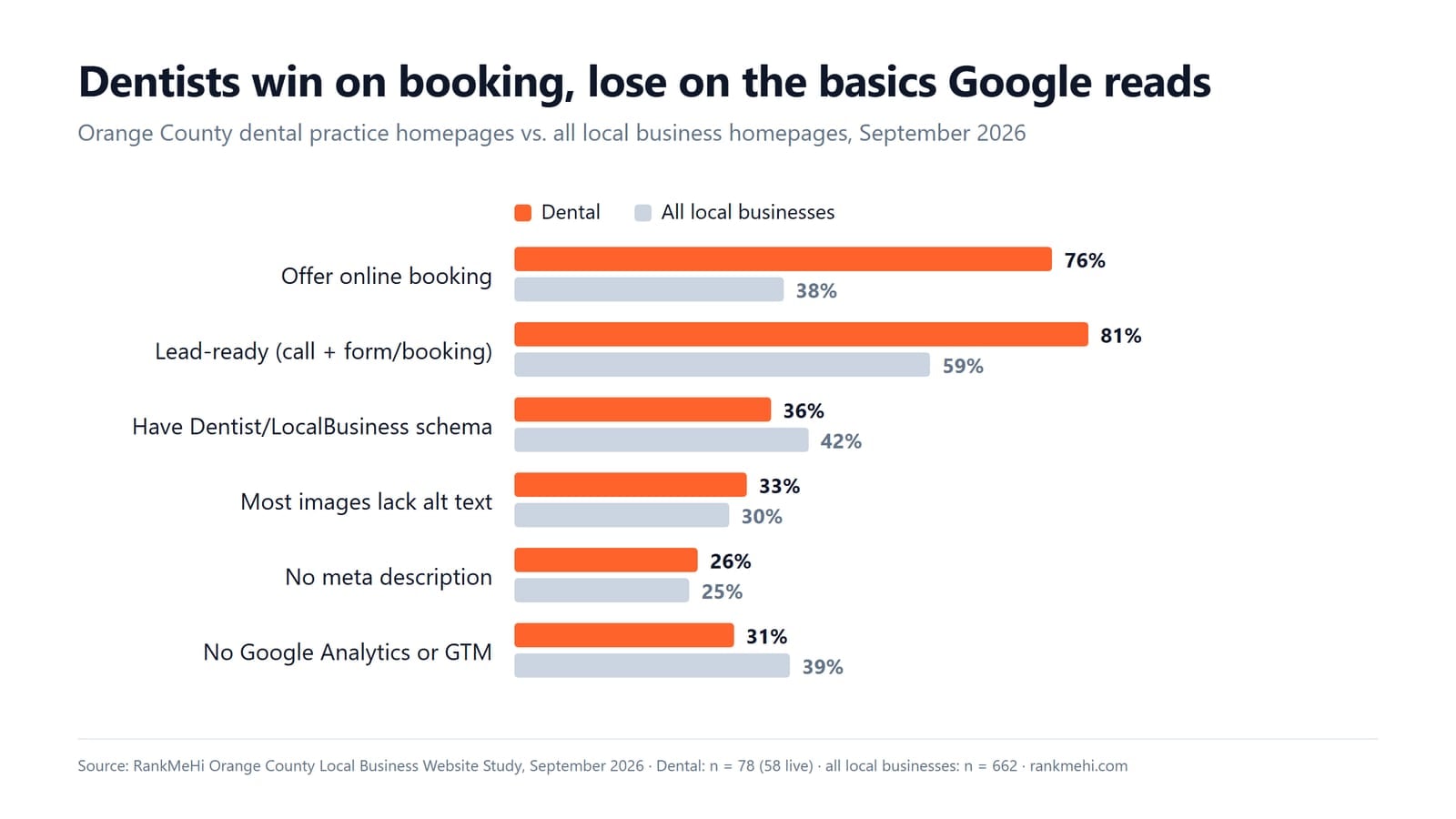
That's a real advantage. It also means a new booking widget is not where most practices should spend their next marketing dollar. The weak points sit earlier in the journey, before a patient ever reaches the booking button.
Why mobile speed is where dental SEO breaks
Because most dental homepages are too heavy to load quickly on a phone, and phones are where people search for a dentist.
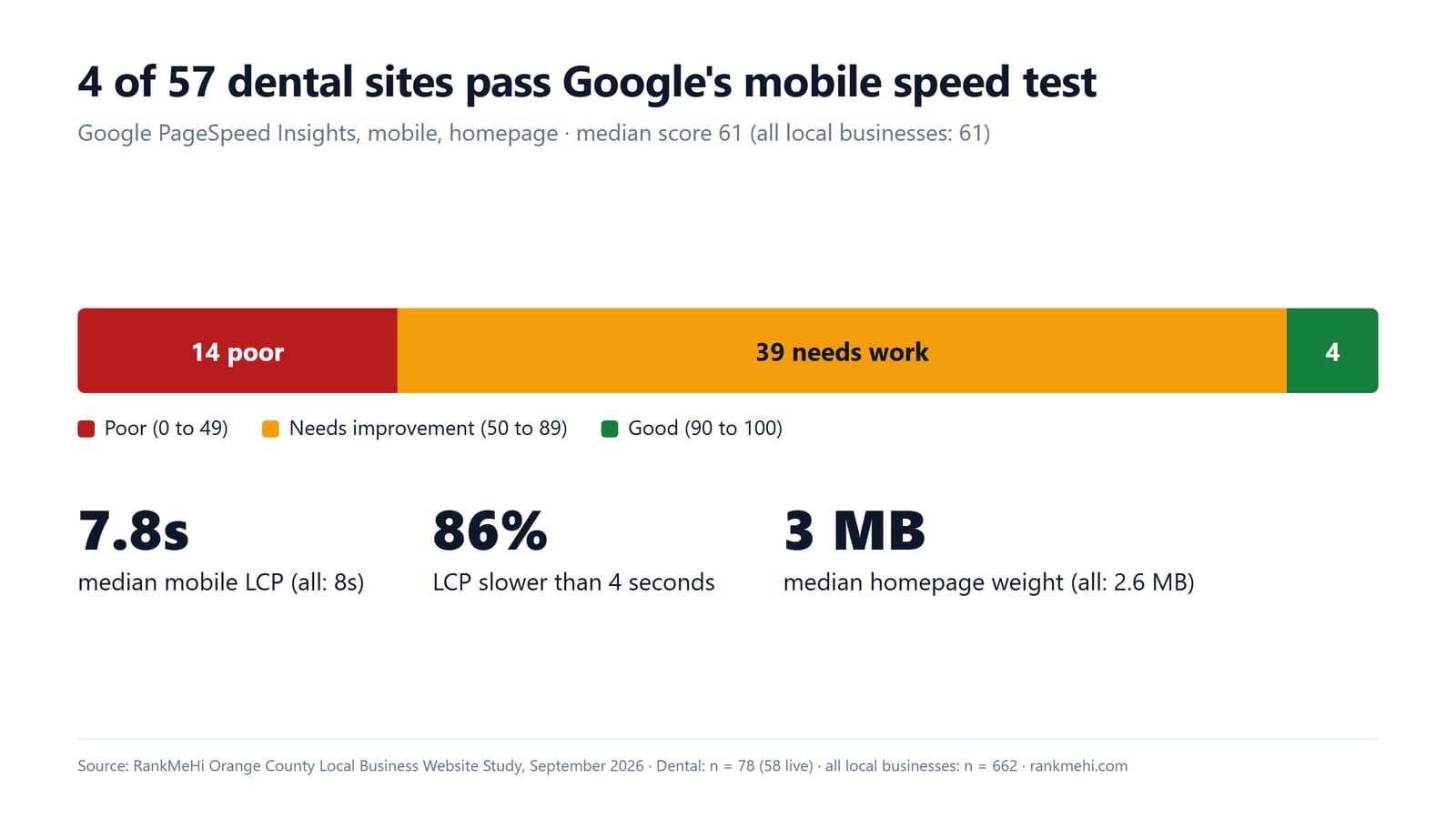
Of the 57 sites with a score, the median mobile PageSpeed score was 61 out of 100. Only 4 of 57 (7%) reached Google's "good" range of 90 or above. Fourteen scored poor, under 50.
The median Largest Contentful Paint (LCP, the time until the main content of the page shows) was 7.8 seconds. Google calls anything under 2.5 seconds good. 86% of dental homepages took longer than 4 seconds.
| Mobile speed (PageSpeed Insights) | Dental sites | All local businesses |
|---|---|---|
| Median score | 61 / 100 | 61 / 100 |
| Score 90+ ("good") | 4 of 57 (7%) | 6.9% |
| Score under 50 ("poor") | 14 of 57 (25%) | 26.9% |
| Median LCP | 7.8 s | 8.0 s |
| LCP slower than 4 s | 86% | 79% |
| Median homepage weight | 3.0 MB | 2.6 MB |
Dental homepages were the heaviest group in the whole study. A median of 3.0 MB usually means full-size photos of the team and office, an autoplaying video header, a review widget, a chat widget and a booking script, all loading before the patient can read anything.
A caching plugin won't fix a 3 MB homepage. The fix is almost always image weight first, then scripts: resize photos to the size they're shown at, serve them as modern formats, load chat and review widgets after the page is usable, and drop the video header on mobile. Our guide to improving website speed walks through the order, and Core Web Vitals explains the three numbers Google reports.
Local SEO for dentists: the signals Google can't find
Most dental sites don't tell Google basic facts about the practice in code. Only 36% have LocalBusiness or Dentist schema, a small block of structured data that states what the business is, where it is and when it's open. The other 64% leave Google to work it out.
The other gaps across the 58 live sites:
- 26% have no meta description, so Google writes the search snippet for them.
- 15.5% have no H1 heading on the homepage.
- 33% leave most images without alt text.
- Only 15.5% mark up reviews with schema, and only 5% use FAQ schema.
- 31% have no Google Analytics or Google Tag Manager at all.
That last one matters more than it sounds. If you can't see which searches and pages bring calls and bookings, you're running dentist SEO blind. You won't know whether a change helped or hurt until months later, if you notice at all.
None of these are hard fixes. On a typical dental site, schema, meta descriptions, headings and alt text are a day of work. That's why we put them near the top of the fix order below.
Why one page per treatment beats a "Services" page
A single Services page can't rank for "dental implants in Irvine." Google wants a page that answers that one search in depth, not a paragraph in a list of twelve procedures.
If you offer implants, Invisalign, emergency care, pediatric dentistry, veneers and root canals, each one needs its own page. Start with the treatments that bring the most revenue per patient. A strong treatment page includes:
| Element | Why patients and Google want it |
|---|---|
| Price range or financing options | Patients decide whether to call based on cost |
| Before-and-after photos (with documented consent) | Proof the result is real |
| The treating dentist's name and credentials | Trust, and Google's E-E-A-T signals |
| A short FAQ about the procedure | Answers the questions people type into Google and AI tools |
| Booking button and tap-to-call | Turns the visit into an appointment |
This is the difference between dental website design that lists what you do and a site built to be found for what you do. Our web design services start from that page list, not from a template.
What Google Business Profile has to do with dental SEO

For "dentist near me" searches, your Google Business Profile often matters more than your homepage, because the map pack sits above the organic results.
Set the primary category to "Dentist" and add secondary categories only for specialties you really offer, such as cosmetic dentist or pediatric dentist. List your services, add the appointment link, upload real photos of the office and team, and reply to every review. Keep your name, address and phone number identical everywhere they appear online.
Ask every patient for a review after the visit. It's the easiest habit that compounds. What you must not do is ask only happy patients, or offer anything in exchange: Google's policy on fake engagement bans both, and a suspended profile costs far more than a slow month. Our Google Business Profile optimization guide covers the full setup.
Will AI search change dentist SEO?
It already sends patients your way or around you. People ask ChatGPT, Perplexity and Google's AI Overviews things like "best dentist for implants in Newport Beach," and the answer names a few practices.
In our sample, 34.5% of dental sites had an llms.txt file, mostly generated automatically by a plugin rather than written on purpose. On the other side, 8.6% refused AI crawlers at the firewall, almost certainly without the owner knowing.
What gets a practice named in those answers isn't a special AI trick. It's the same foundation that works for classic dental SEO services: a clear page per treatment, real reviews, schema, consistent listings, and a site the crawlers can actually open. We explain how AI assistants choose which businesses to mention in our AI search optimization service.
Booking widgets don't create patients. They catch the ones your site was fast and clear enough to keep.
What dentists ask before paying for SEO
We read through what practice owners say when they talk to each other on Reddit's dental forums. Three questions come up again and again, and they're fair ones.
"Every agency says it has the secret sauce." It doesn't. Dental SEO is a known list of work: speed, schema, treatment pages, Google Business Profile, reviews, tracking and links. Ask any agency which of those it will do in month one and how you'll see the result.
"We do fine on referrals, but almost nothing comes from Google." That's common for a practice a few years old. Referrals fill the chair while the website sits unseen. The map pack is usually the fastest place to change that.
"Isn't word of mouth better?" For loyalty, yes. But new residents and people with an emergency don't have a friend to ask at 9 p.m. They have a phone.
Want to know which of these gaps your site has? We'll check speed, schema, treatment pages and your Google profile, then send a short list in fix order. Request a free dental website audit.
The dental SEO fix order
Cheapest and fastest first, then content and links. Based on what we found across these 78 sites, this is the order we'd use:
- Cut image weight and fix mobile speed. Target a homepage under 1.5 MB and LCP under 2.5 seconds.
- Add Dentist schema to the homepage and each location page.
- Write meta descriptions, one H1 per page and alt text for every meaningful image.
- Build one page per treatment, starting with your highest-value services.
- Clean up Google Business Profile categories, services, hours, appointment link and photos.
- Set up a simple review request sent to every patient after the visit.
- Install analytics and call tracking so you can see which searches bring patients.
- Add location pages only for offices you actually operate, not for every nearby city.
- Answer real patient questions in short articles that link to the treatment pages.
- Earn links from local business groups, sponsorships, dental associations and local press.
Start at the top. A practice that fixes speed and schema before writing blog posts usually sees more movement than one publishing content on a 7.8-second homepage.
How much dental SEO costs and how long it takes
Cost depends on who does the work and how much is broken at the start. Owners on dental forums mention about $1,500 a month as a common floor for agency work, and many pay more. Here's how the options compare:
| Option | What you get | Typical cost |
|---|---|---|
| Do it yourself | Full control, but you learn schema, speed tools and Google Business Profile from scratch | Your time |
| Freelancer | Lower cost; quality and availability vary | Varies widely |
| Dental marketing agency | SEO often bundled with ads and content | Monthly retainer, often $1,500+ |
| RankMeHi | Audit and fix, then optional ongoing growth; custom web development when the site itself is the problem | Audit and fix from $490, growth from $690/month, new site from $2,490 |
In our experience, and not as a guarantee, map pack movement tends to show 8 to 12 weeks after the technical and profile fixes go live. Organic rankings for treatment pages usually take 4 to 9 months, depending on how competitive your city is. Our SEO cost guide breaks down the pricing models in more detail.
What RankMeHi does for dental practices
We start with the same checks used in this study, on your site and your Google profile, then fix what we find in the order above. If the site is too slow or too thin to save, we rebuild it with one page per treatment, Dentist schema, compressed images and booking that works on a phone. Ongoing local SEO services cover the profile, reviews, tracking and links each month.
See how we work with dental practices, or look at our case studies for other local businesses.
When you don't need a dental SEO agency
Be honest about where you are. If you're a single-location practice already booked six weeks out, SEO will mostly add patients you can't see. Fix the basics in this post yourself and revisit later.
And if new-patient calls go to voicemail or nobody calls back web bookings within the hour, fix that first. No ranking can save a lead the front desk misses.
Key takeaways
- Dentists already lead on booking: 76% offer online booking, double the local average.
- Speed is the real gap: only 4 of 57 dental homepages pass Google's mobile test, and they're the heaviest sites we measured.
- 64% of dental sites have no Dentist or LocalBusiness schema, and 31% have no analytics.
- One page per treatment, a complete Google Business Profile and a steady review habit do most of the ranking work.
- Fix in order: speed, schema and basics, treatment pages, profile, reviews, tracking, then content and links.
FAQ
How long does SEO take for dentists?
Map pack changes often show 8 to 12 weeks after speed, schema and Google Business Profile fixes go live. Organic rankings for treatment pages like implants or Invisalign usually take 4 to 9 months. Competitive cities and brand-new domains take longer. Steady reviews and new treatment pages keep the progress going.
How much does dental SEO cost?
Agency retainers commonly start around $1,500 a month and rise with the number of locations and treatments. A one-time audit and fix is cheaper and often solves the biggest problems. RankMeHi's audit and fix starts at $490, ongoing growth at $690 a month, and a new dental website at $2,490.
Is local SEO for dentists different from regular SEO?
Yes. Local SEO for dentists focuses on the map pack: Google Business Profile, reviews, consistent name, address and phone, Dentist schema and location pages. Regular SEO focuses on organic results for treatment and question searches. A practice needs both, but the map pack usually brings bookings sooner.
Do dentists need a blog for SEO?
Not first. Treatment pages, speed and your Google profile matter more. Once those are done, short articles that answer real patient questions, like what to do after a cracked tooth, can bring searchers and link them to the right treatment page. Publish only what a patient would actually want to read.
Can a dentist do SEO themselves?
Partly. Google Business Profile, review requests, meta descriptions and photos are easy to handle in-house. Mobile speed, schema and site structure usually need a developer. Many practices do the profile work themselves and pay for a one-time technical fix, which is often the most cost-effective split.
Get found before the patient gives up
The practices that win in local search aren't the ones with the fanciest booking widget. They're the ones that load fast on a phone, tell Google clearly what they do, and have a page for every treatment people search for.
If you want to know where your practice stands, we'll check your site and Google profile against everything in this study and send you a short, prioritized list. Book your free website and SEO audit.
Services mentioned in this article
RankMeHi designs and builds business websites, then makes sure they are found and convert. Start with the two pages below.