
Someone was just served divorce papers. It's past midnight, and they're not calling anyone yet. They're typing "best family lawyer in Irvine" into ChatGPT, then into Google, and comparing what each one tells them.
That's where SEO for law firms stands in 2026. We checked 53 Orange County law firm websites with the same tests we run on every local business. Law firms do the classic SEO homework better than almost any other industry we've studied. But nearly a quarter of their sites turn away the AI tools prospective clients now use, and most are slow on the phones those clients are holding.

Quick answer: SEO for law firms means showing up in the map pack, organic results and AI answers when someone searches a practice area plus a city, then turning that visit into a consultation. Our study of 53 Orange County firm sites found strong schema and sitemap habits, weak mobile speed, and 23% of live sites refusing AI crawlers without the owners likely knowing.
Is your firm's site one of the 1 in 4? We'll test whether ChatGPT, Claude and Perplexity can read it, check mobile speed and intake, and send a short fix list, free. Get a free website and SEO audit.
What we checked
We took 53 law offices from OpenStreetMap listings across Orange County, California, crawled each homepage on September 25, 2026, and ran Google PageSpeed Insights (mobile) on every live site the next day.
Of the 53 sites, 47 were live. Three were broken or gone, a 5.7% failure rate, the lowest dead-site rate of any local industry in our Orange County local business website study of 662 sites. Lawyers, at least, keep their sites online.
Law firms already do the classic SEO checklist
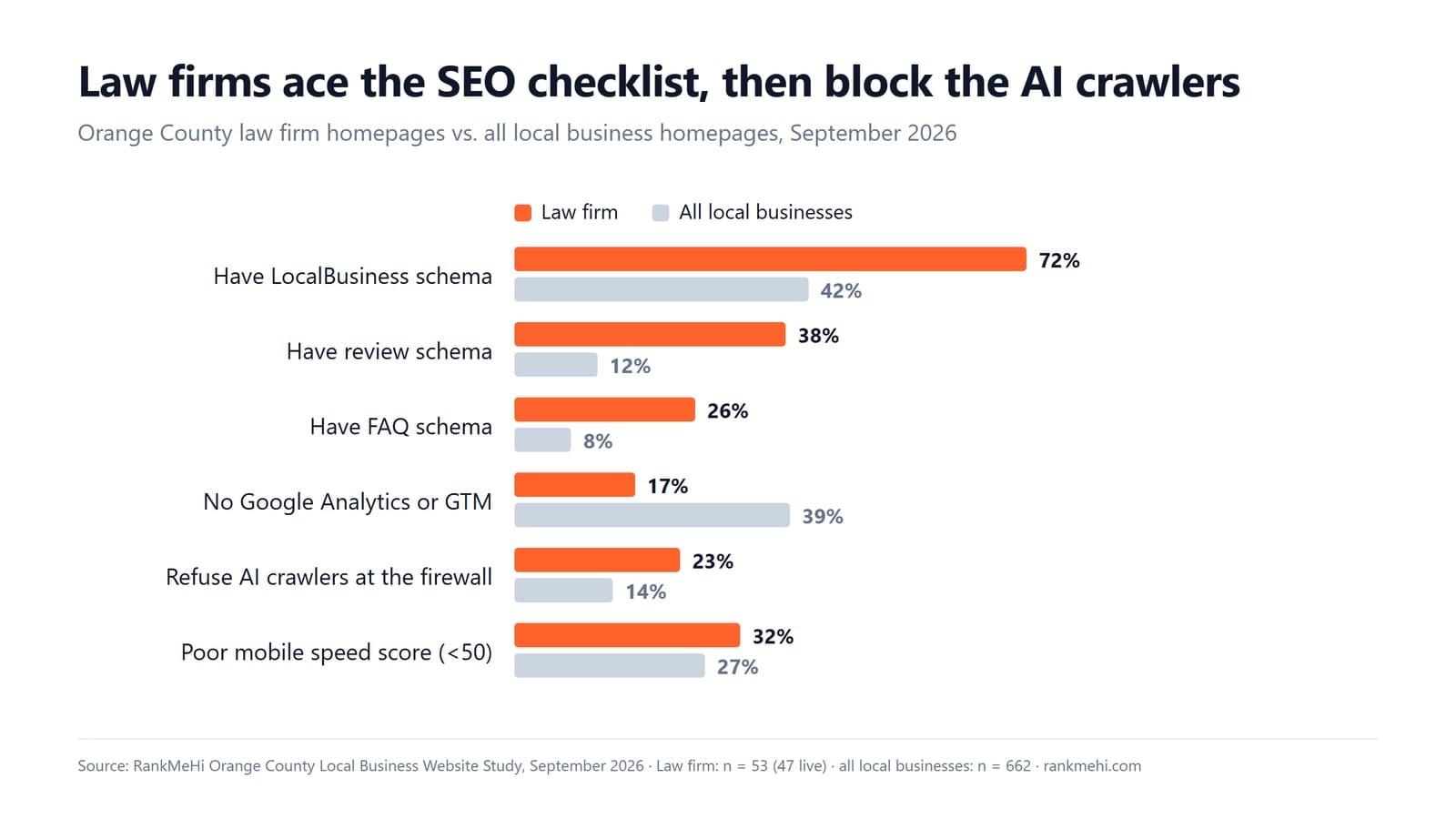
Law firms beat the typical local business on nearly every basic signal we track.
| Signal | Law firms | All 662 local businesses |
|---|---|---|
| LocalBusiness / LegalService schema | 72% | 41.5% |
| Review schema | 38% | 11.7% |
| FAQ schema | 25.5% | 8% |
| XML sitemap | 100% | about 90% |
| No Google Analytics or Tag Manager | 17% | 39% |
| No meta description | 17% | 25% |
| Generic "Home" page title | 0% | 6% |
| Copyright year 2024 or older | 6% | 28% |
Three in four firm sites (75%) run on WordPress, usually with an SEO plugin doing the schema and sitemap work. If you're a managing partner who believes your firm already has the fundamentals of attorney SEO covered, the data says you're probably right. The gap is somewhere else.
The blind spot: 1 in 4 firm sites refuse AI crawlers
Eleven of the 47 live firm sites, 23.4%, refused requests from GPTBot, ClaudeBot or PerplexityBot at the firewall or CDN level. Across all 662 local businesses, 13.9% did the same.
None of those 11 sites blocked the crawlers in robots.txt, the file where a site owner states on purpose which bots may visit. So the refusal came from a security layer, a host setting or a CDN's bot protection, most likely switched on without anyone at the firm deciding it.
Why it matters for a firm: people now ask AI assistants for lawyer recommendations the way they'd ask a friend. If the assistant's crawler gets a blocked response, it has nothing to read, nothing to cite and no reason to name your firm. Our request came from our own server with the crawler's user agent, and some firewalls verify real crawler addresses, so treat a refusal as a warning sign to check, not proof.
Checking takes five minutes. Look at your CDN's bot settings (Cloudflare calls the relevant options bot fight mode and AI crawler blocking), or ask your host whether AI crawlers like OpenAI's GPTBot are allowed. Then decide on purpose. Some firms will choose to block training crawlers and allow the search ones. Most firms we found never chose anything. Our AI search optimization service starts with exactly this check.
A firm that blocks AI crawlers by accident isn't protecting anything. It's just missing from the answer.
Speed on phones
All 47 live firm sites got a Google PageSpeed Insights mobile score. The median was 62 out of 100, barely above the 61 median for all local businesses.
| Mobile speed (PageSpeed Insights) | Law firms | All local businesses |
|---|---|---|
| Median score | 62 / 100 | 61 / 100 |
| Score 90+ ("good") | 3 of 47 (6.4%) | 6.9% |
| Score under 50 ("poor") | 15 of 47 (32%) | 26.9% |
| Median Largest Contentful Paint | 6.8 s | 8.0 s |
| Median homepage weight | 2.4 MB | 2.6 MB |
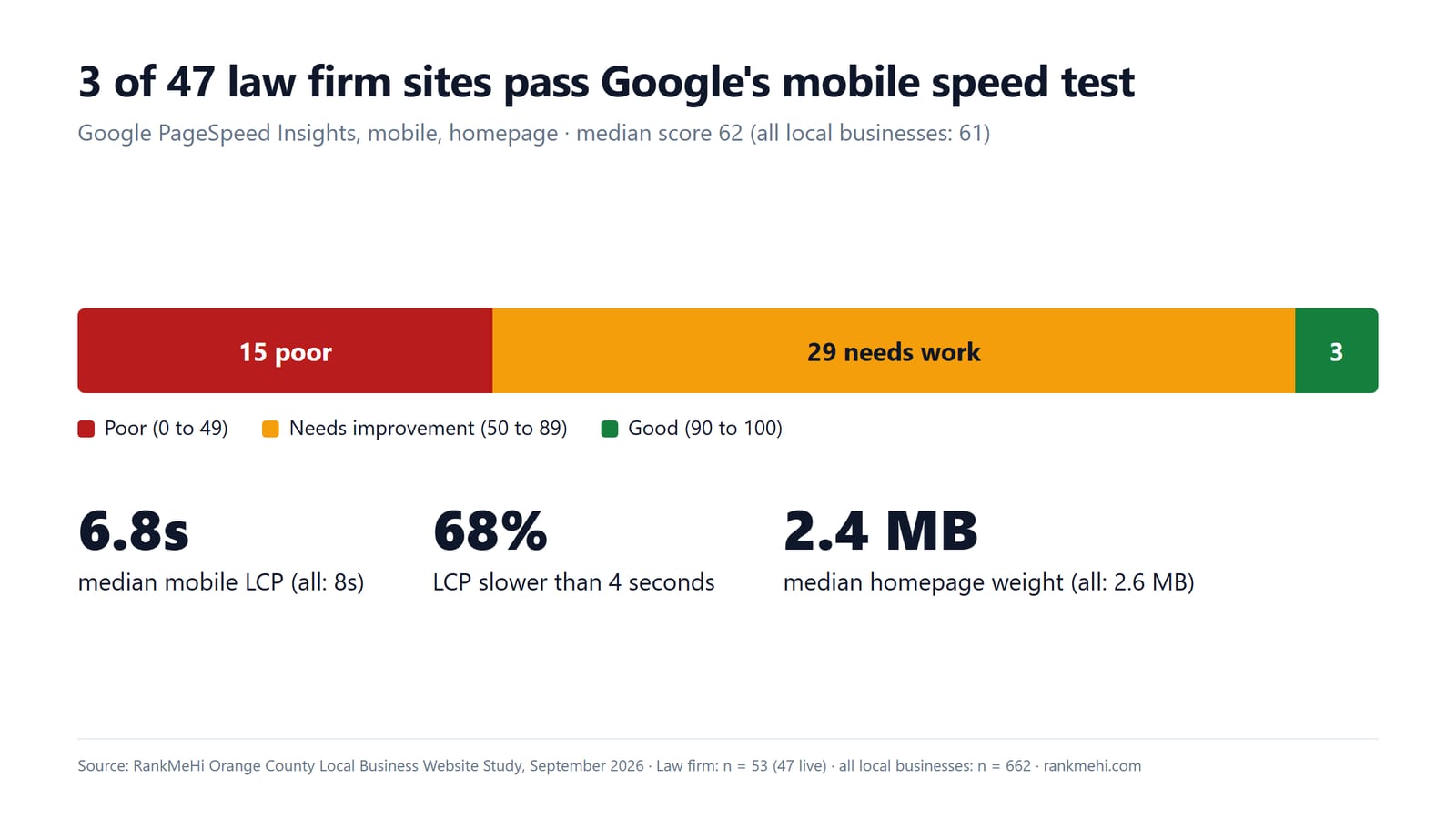
The main content took a median 6.8 seconds to appear, against Google's 2.5-second target for a good Largest Contentful Paint. The same culprits showed up again and again: autoplaying video headers, chat widgets that load before the page does, image sliders and a stack of tracking scripts. None of them are essential on a law firm homepage, and most can be deferred. Our guide to improving website speed shows the order we'd remove them in.
Lawyer SEO by practice area: one page per case type
If personal injury, family law and criminal defense share one "Practice Areas" page, both Google and the client have to guess. Build one page per case type instead.
For personal injury that means separate pages for car accidents, truck accidents and slip and fall cases. For family law, divorce and custody. For criminal defense, a dedicated DUI page. Personal injury lawyer SEO rewards this specificity most, because searchers already know what happened to them before they start looking.
| A practice area page should answer | Why |
|---|---|
| Who it's for, in their words | Matches how people search ("hit by a delivery truck") |
| What the process looks like | Lowers the fear of calling |
| How fees work (contingency, flat, hourly) | The question most people won't ask out loud |
| Which attorney handles it, with credentials | Trust, and the expertise signals Google looks for |
| Past results, within bar advertising rules | Proof, with the disclaimers California requires |
| FAQ and an intake form on the page | Answers objections and captures the lead in one place |
On results and testimonials, check the State Bar of California's Rules of Professional Conduct on advertising before publishing. We build the pages; the firm owns the compliance call. Our law firm web design guide covers the intake form and page layout in more detail, and our work for personal injury lawyers shows how we structure these sites.
Local SEO for attorneys
Local SEO for attorneys starts with Google Business Profile, and most firms treat it as an afterthought.
Create one profile per real office, not per practice area, and choose the primary category that matches the firm's main work (personal injury attorney, family law attorney, criminal justice attorney) with secondary categories for the rest. Skip virtual offices and co-working addresses. Google verifies them more strictly now, and a suspended profile costs more than the extra location could bring.
Ask for reviews after a matter closes, from every client, with a simple link. Never write them, buy them or reward only positive ones. Keep the firm's name, address and phone number identical on your website, your Google profile and legal directories such as Avvo, Justia, your State Bar profile and your local bar association's member directory. Our local SEO services handle that consistency work every month.

What managing partners ask before hiring an SEO firm
We read what firm owners say to each other on Reddit's law firm forums. The same worries come up again and again.
- Red flags. Guaranteed rankings, long lock-in contracts, vague monthly reports, and national SEO campaigns sold to a solo practice that serves one city.
- "Am I wasting money?" Owners in big-city markets paying for months with no movement in rankings or calls.
- Bringing it in-house. Firms asking what they need to learn to supervise SEO themselves once the foundation is built.
All three are fair. Nobody honest can promise a position on Google. A monthly report should show what changed on the site and what happened to calls and consultations, not just a ranking chart. And once speed, pages and the profile are fixed, in-house maintenance is a reasonable plan.
Want a second opinion on your current SEO vendor? Send us the last three monthly reports and your site. We'll tell you plainly what's being done and what isn't. Ask for a free SEO review.
Links law firms can actually earn
Law firm SEO doesn't need bought links. Your local bar association's member directory, your law school's alumni pages and the State Bar profile are a start.
After that: speak at local events, publish plain-English guides to common legal processes, sponsor community organizations, and answer local reporters' questions on legal topics. Each one earns a link a competitor can't simply buy. Avoid paid link packages, which mostly come from low-quality directories that hurt more than help.
SEO for law firms: the fix order
If the firm were ours, this is the order:
- Check AI crawler access at the firewall and CDN, and decide on purpose.
- Fix mobile speed: remove autoplay video headers, load chat on click, cut unneeded tracking scripts.
- Build one page per practice area and case type, with fees, process, attorney and intake form.
- Write attorney bio pages with bar admissions, education and the matters each lawyer handles.
- Clean up Google Business Profile for each real office.
- Make name, address and phone consistent on the site and every directory.
- Ask every client for a review with a simple link after the matter closes.
- Track calls and form submissions so you can see which pages bring consultations.
- Publish guides that answer client questions and link them to the practice pages.
- Earn local links from the bar association, alumni pages, sponsorships and press.
Re-check AI crawler access every quarter. Hosting and security settings change without notice.
What law firm SEO costs
Firm owners comparing notes online report legal marketing retainers from about $1,000 to over $10,000 a month, depending on the market and the scope.
| Approach | What it includes | Cost |
|---|---|---|
| Do it yourself | Your own time and free tools; slow, but no fee | Your time |
| Legal marketing agency | SEO, often bundled with ads and content | About $1,000 to $10,000+ a month (owner reports) |
| RankMeHi | Audit and fix, then optional monthly growth; custom web development or new web design services when the site is the problem | Audit and fix from $490, growth from $690/month, new site from $2,490 |
Timelines, in our experience and not as a promise: map pack movement often shows 8 to 12 weeks after the profile and technical fixes, and practice area pages in competitive cities usually take 6 to 12 months to reach page one. Our SEO cost guide explains the pricing models.
When a law firm doesn't need SEO help
If your firm runs on referrals and the pipeline is full, SEO for lawyers can wait. Spend the budget where it pays now.
And if intake takes a day or more to call back, fix that first. A well-ranked site feeding a slow intake team loses to an average site with a fast callback every time.
Key takeaways
- Law firms beat other local businesses on SEO basics: 72% have LocalBusiness schema and every live site in our sample had a sitemap.
- 23.4% of live firm sites refused AI crawlers at the firewall, and none had blocked them in robots.txt.
- Only 3 of 47 firm homepages scored "good" on Google's mobile speed test; 32% scored poor.
- One page per practice area and case type beats a single combined page.
- Fix AI crawler access and mobile speed before paying for more content or links.
FAQ
How long does SEO take for a law firm?
In our experience, map pack changes often appear 8 to 12 weeks after the Google Business Profile and technical fixes go live. Practice area pages in competitive cities usually need 6 to 12 months to reach page one. Nobody can guarantee a timeline, so be wary of any vendor that does.
How much does law firm SEO cost?
Firm owners report agency retainers from about $1,000 to over $10,000 a month, depending on city and scope. A one-time audit and fix often solves the biggest problems first. At RankMeHi, an audit and fix starts at $490, ongoing growth at $690 a month, and a new firm website at $2,490.
Is personal injury lawyer SEO harder?
Usually, yes. Personal injury has more searches, more competing firms and higher ad prices than most practice areas, so page one takes longer. Smaller firms compete best on specificity: a page per case type and per city they really serve, strong reviews, and fast mobile pages that turn visits into calls.
Should a law firm block AI crawlers?
Only on purpose. In our study, 23.4% of firm sites refused AI crawlers at the firewall while none blocked them in robots.txt, which suggests most owners don't know. If you want to appear in ChatGPT, Claude or Perplexity answers, allow their search crawlers and decide separately about training crawlers.
Do lawyers need a blog for SEO?
Not first. A strong page for each practice area and case type usually brings more consultations than general blog posts. Once those pages exist, short guides that answer real client questions, like how custody is decided in California, can bring searchers and send them to the right practice page.
Find out what Google and AI can see
Your firm probably did the old SEO checklist well. The question now is whether the newest places clients ask for a lawyer can read your site at all, and whether it loads before a stressed person on a phone gives up.
We'll check AI crawler access, mobile speed, your practice pages and your Google profile, then send you a short list in fix order. Book your free website and SEO audit.
Services mentioned in this article
RankMeHi designs and builds business websites, then makes sure they are found and convert. Start with the two pages below.